Our Products
Plant-Based Soft Capsule Solutions for Nutritional Supplements, Functional Gel Candy & Color Cosmetics — plus an emerging Intimate Wellness segment
What We Offer
Amylom Biotechnology operates three core businesses around our proprietary pregelatinized hydroxypropyl starch technology — a dual-modified plant-based starch, ChP-listed and GB 29930-2013 compliant. (1) hydroxypropyl starch shell materials in three grades — Clear, Natural, and Tailor-Made; (2) softgel production-line engineering — gel-mass tanks built in-house, paired with encapsulation machines and dies from long-standing OEM partners; (3) integrated softgel manufacturing — you bring the fill, we bring the shell platform plus encapsulation, drying, and finishing.
01 — Material
Hydroxypropyl Starch Capsule Material
Plant-based shell material for soft capsules — supplied as hydroxypropyl starch powder in three grades.
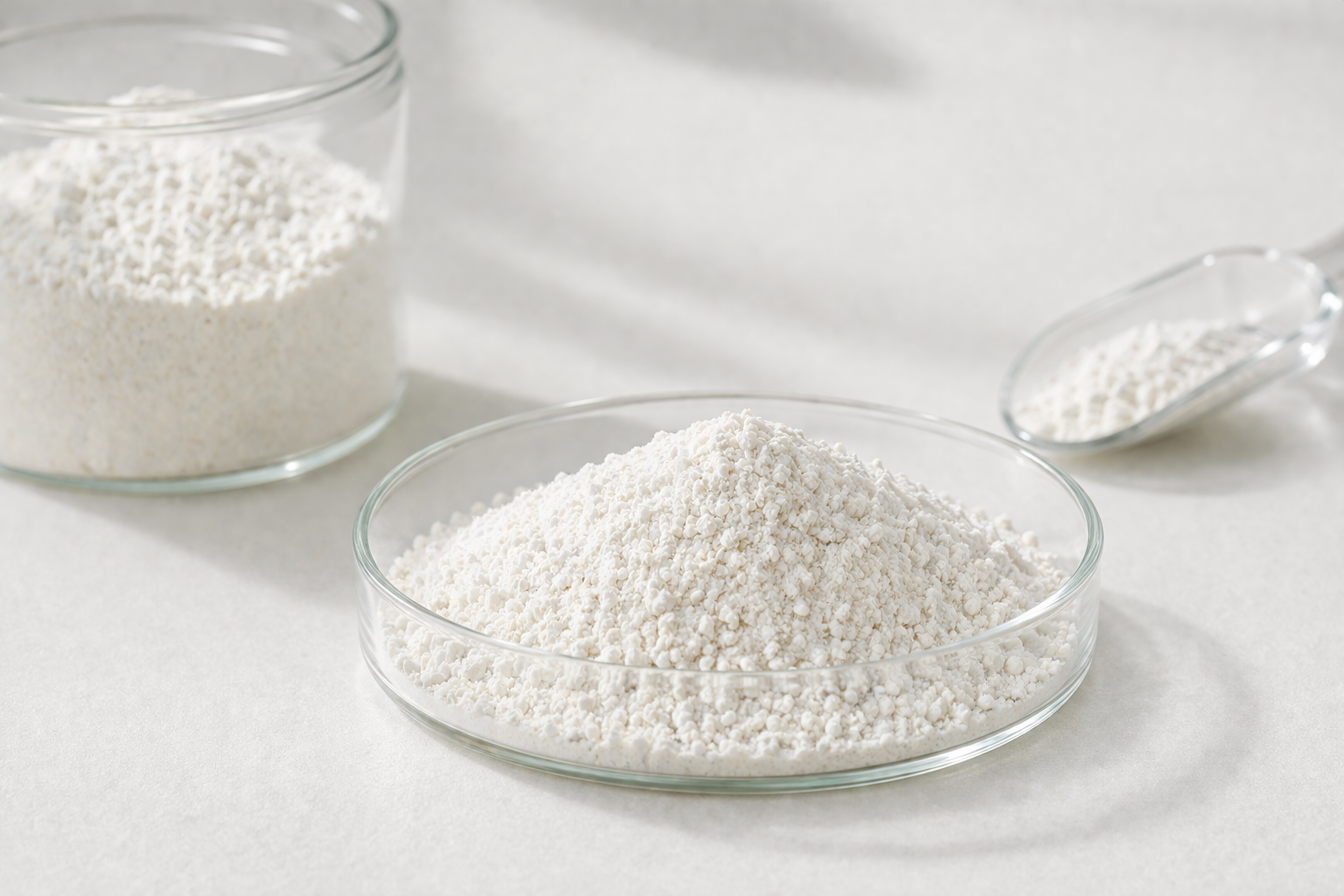
Pregelatinized Hydroxypropyl Starch
Plant-Based Capsule Material
Our pregelatinized hydroxypropyl starch — a dual-modified starch, chemically hydroxypropylated and physically pregelatinized — is manufactured from non-GMO corn, potato, cassava, and pea starches. ChP-listed pharmaceutical excipient, GB 29930-2013 compliant, HALAL certified (JAKIM, BPJPH, OIC-SMIIC and GCC). Supplied in 25 kg/bag powder form, it is the primary shell material for plant-based soft capsules across nutritional supplements, functional gel candy, and color cosmetics — plus emerging intimate-wellness applications.
The AMYLOM® Series — Three Powder Grades
Clear
AMYLOM® Clear
Pure-starch grade
All-starch shell — the gel network is built from plant starch alone, with no carrageenan, gellan, or animal gelatin.
Best for: color cosmetics, skincare, and premium clean-label supplements where shell clarity and carrageenan-free sourcing matter.
Natural
AMYLOM® Natural
Blended plant-gel grade
Hydroxypropyl starch blended with a plant gel (carrageenan or gellan); mainstream cost-performance.
Best for: high-volume nutritional supplements where mainstream cost-performance is the priority.
Tailor-Made
AMYLOM® Tailor-Made
Custom-formulated shell
Custom shell formulas by application — for example, chewable gel candy and other specialty fills.
Best for: gel candy, chewables, and projects needing custom color, shape, or fill volume.
Our shells support a range of end-product capsule formats: oil-based / powder fills · crystal-clear / custom-color / pearl-opaque shells · custom shape, size, and fill volume on request.
Key Advantages
- Crystal-clear shell — premium visual quality for color cosmetics and skincare
- Up to 1:3.6 gel yield ratio
- Gel mass stable for 72 hours after cooking
- Custom formula and process supported per client specification
- Compatible with continuous tumbler drying or tray drying
Specification
| Product Name | Pregelatinized Hydroxypropyl Starch |
|---|---|
| Standard | GB 29930-2013 |
| Appearance | White to off-white powder or granule |
| Shelf Life | 24 months |
| Packaging | 25 kg/bag |
| Storage | Cool and dry conditions |
| Hydroxypropyl | ≤7.0 g/100g |
| Moisture | ≤15% |
| Heavy Metals | Pb ≤1.0 mg/kg, As ≤0.5 mg/kg |
| Microbial | Total ≤1000 cfu/g Mold & yeast ≤50 cfu/g Coliforms ≤0.43 mpn/g Salmonella & S. aureus: not detected |
| Certifications | Active: HALAL (JAKIM, BPJPH, OIC-SMIIC, GCC); U.S. FDA Food Facility Registration (No. 11534354992); GB 29930-2013; GB 2760-2024. Under Application: Non-GMO, Vegan, Organic, NDF, ISO. |
Why Plant-Based Over Gelatin?
Plant-based capsules serve the vegan, halal, kosher, and allergen-sensitive buyers that gelatin shuts out.
| Gelatin | AMYLOM® Plant-Based | |
|---|---|---|
| Clean Label | ✕Animal-derived | ✓Non-GMO, fully traceable |
| Green Production | ✕Wastewater & odor | ✓No wastewater or odor output |
| Heavy Metal Risk | !Chromium, lead risk | ✓None — plant sourced |
| Cross-Linking | !Reacts with fill materials | ✓Chemically inert starch |
| Storage Conditions | !Strict temp & humidity | ✓Flexible — no strict control needed |
| Odor | !Possible in product | ✓Odor-free |
| Allergen Risk | !May cause reactions | ✓Allergen-free |
| Vegan / Halal / Kosher | ✕Not suitable | ✓Certified — suitable for all |
| Consumer Compatibility | ✕Excludes vegan, religious & sensitive consumers | ✓Universal — vegan, halal, kosher, allergen-free |
| Shell Appearance | Opaque / yellowing over time | ✓Crystal-clear, no yellowing over time |
02 — Equipment
Softgel Production-Line Engineering
Purpose-built equipment for plant softgel production — designed around plant-starch shell material properties, sized for lab to commercial scale.
Why plant softgels need specialized equipment
Plant gel has higher viscosity, weaker fluidity, weaker initial seam strength, and lower coating tensile strength than gelatin. It requires higher gel-mass cooking and supply temperatures and is more sensitive to environmental conditions — making purpose-built equipment essential for reliable commercial production.
Equipment Line-up
Some components built in-house; others sourced from OEM partners of over a decade. Encapsulation machines and spreader boxes from a Chinese machinery OEM. Die rolls from a tooling specialist holding 80%+ domestic share, shipping 2,000+ die sets annually to 30+ countries.
Built in-house
Gel-Mass Tank
- 300–450 L, commercial production size
- External-circulation heating for uniform temperature
- Specialized stirring design for plant gel
- Optional one-touch automated control
OEM partner
Softgel Encapsulation Machine + Spreader Box
- Linear servo medicine pump — fill error within ±1%
- Self-heating gel intake pipe; adjustable airflow
- Auto-startup self-check; automatic die roll alignment
- Injection timing, dosing and ribbon lubrication track die roll speed automatically
OEM partner
Custom Die Rolls
- Purpose-designed seam-cutout geometry for stronger seaming
- Stars, hearts, droplets, oval, oblong shapes
- Die roll precision: 0.001–0.003 mm
- Dense layout to reduce per-unit cost
Standard Operating Parameters
| Spreader box temperature | 88–92°C |
| Gel supply pipe | 88–92°C |
| Gel supply pressure | 0.03–0.09 MPa |
| Cooling drum temperature | 15–25°C |
| Wedge temperature | 22–45°C |
| Ambient temperature | 18–24°C |
| Ambient humidity | ≤40% RH |
| Die roll speed | 1–5 RPM (typical 2.5–3 RPM) |
| Gel ribbon thickness | 0.4–0.7 mm (typical 0.6 mm) |
03 — Service
Integrated Softgel Manufacturing
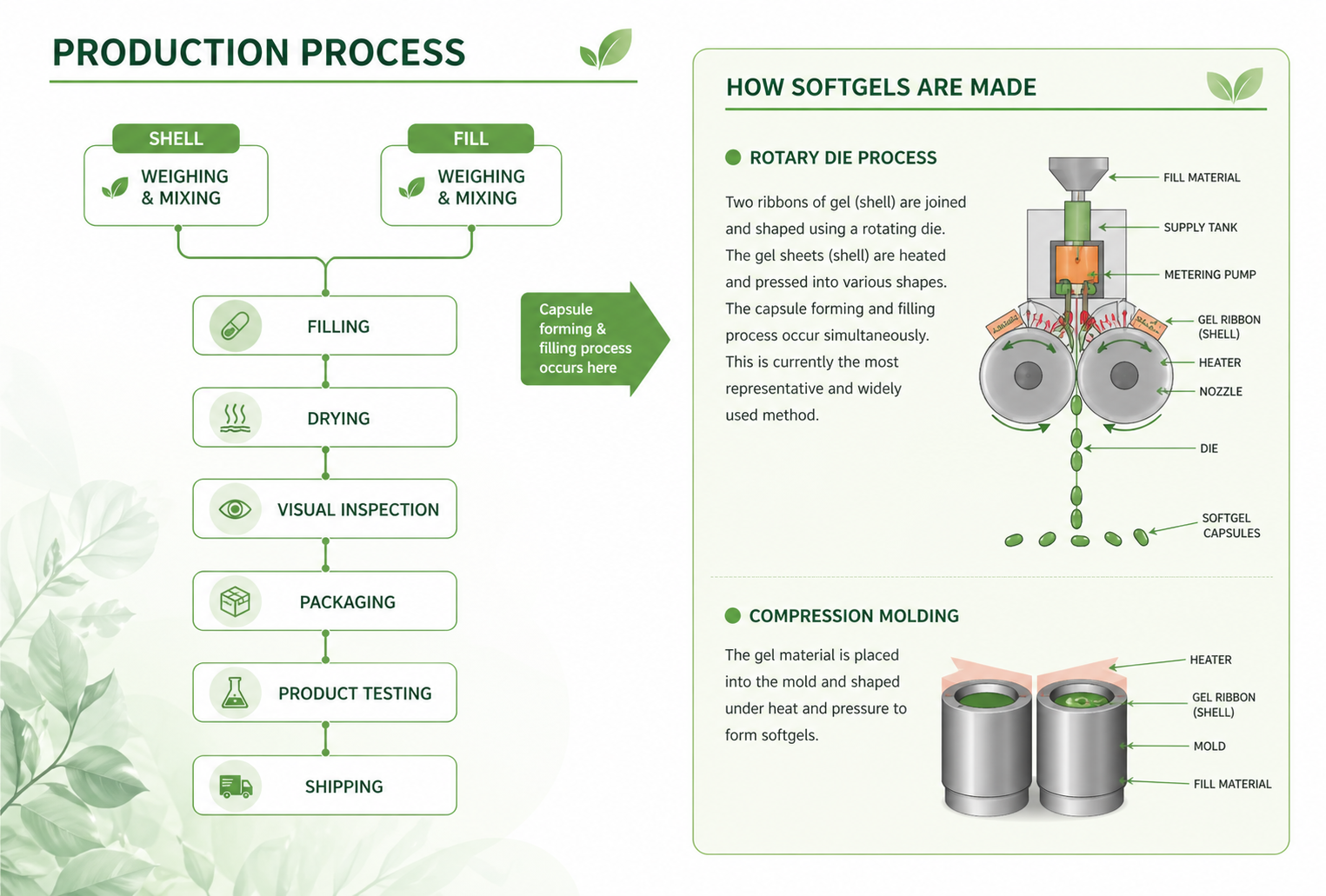
You bring the fill. We bring the hydroxypropyl starch shell platform plus encapsulation, drying, and finishing — from lab trial through pilot to commercial scale. The shell formulation stays with us, so reformulation and stability work move off your roadmap.
Service Scope
Our team supports clients across every stage of softgel manufacturing — gel-mass cooking, compression, drying, fill formulation, and shell engineering — with formula adaptation, parameter tuning, and process validation tailored to each project.
| Stage | Parameters and Tuning |
|---|---|
| Gel-Mass Cooking | Temperature, time, process protocol |
| Encapsulation | Temperature, die roll speed, seaming, lubrication |
| Drying | Time, humidity, temperature, airflow |
| Fill Formulation | Recipe, particle size, emulsification |
| Shell Engineering | Thickness, transparency, seam integrity |
From Lab to Commercial Scale
- Lab trial — formulation development, small-batch validation, fill compatibility testing
- Pilot scale-up — pilot batches with refined process parameters, packaging trials
- Commercial production — full-scale runs with quality assurance and stability testing
Frequently Asked Questions
What is the AMYLOM softgel shell made of?
AMYLOM plant-based softgel shells are made from hydroxypropyl starch and are free from animal gelatin. Clear is an all-starch shell that is carrageenan-free; Natural blends hydroxypropyl starch with a plant gel (carrageenan or gellan) for mainstream cost-performance; Tailor-Made covers custom shell formulas built on either base.
Is the AMYLOM softgel shell vegan, halal, and non-GMO?
Yes. The shell is plant-based and HALAL certified — recognized by JAKIM (Malaysia), BPJPH (Indonesia), OIC-SMIIC, and GAC (GCC) — made from non-GMO corn, potato, cassava, and pea starch.
Can AMYLOM shells run on existing gelatin encapsulation lines?
Yes. It is drop-in compatible with standard gelatin softgel encapsulation lines, with no equipment changes and no formulation rebuild required.
What product grades are available?
Three grades: Clear (all-starch, carrageenan-free shell), Natural (hydroxypropyl starch blended with carrageenan or gellan), and Tailor-Made (custom shell formulas, such as chewable gel candy).
What standards and certifications does the material meet?
It is listed in the Chinese Pharmacopoeia (ChP), compliant with GB 29930-2013 and GB 2760-2024, HALAL certified (recognized by JAKIM, BPJPH, OIC-SMIIC, and GCC), and SGS-tested for heavy metals, microbial load, and identity.
What fills are AMYLOM shells compatible with?
Oil, suspension, and powder fills, including fish oil, evening primrose oil, vitamin D3, CoQ10, and calcium suspensions.
Is a hydroxypropyl starch shell the same as a vegetarian softgel or V-gel?
Vegetarian softgel — V-gel in equipment and trade usage — is the industry name for a softgel whose shell contains no animal gelatin. AMYLOM is the hydroxypropyl starch route to that category, and it runs on standard encapsulation lines with no equipment change.
Ready to Switch to Plant-Based?
Talk to our team about your formulation needs.